Vision
“To promote and cultivate Science and Technology for societal welfare through the advancement of research and innovation.”
Hosted by BHU & IIT (BHU), Varanasi
About NASI
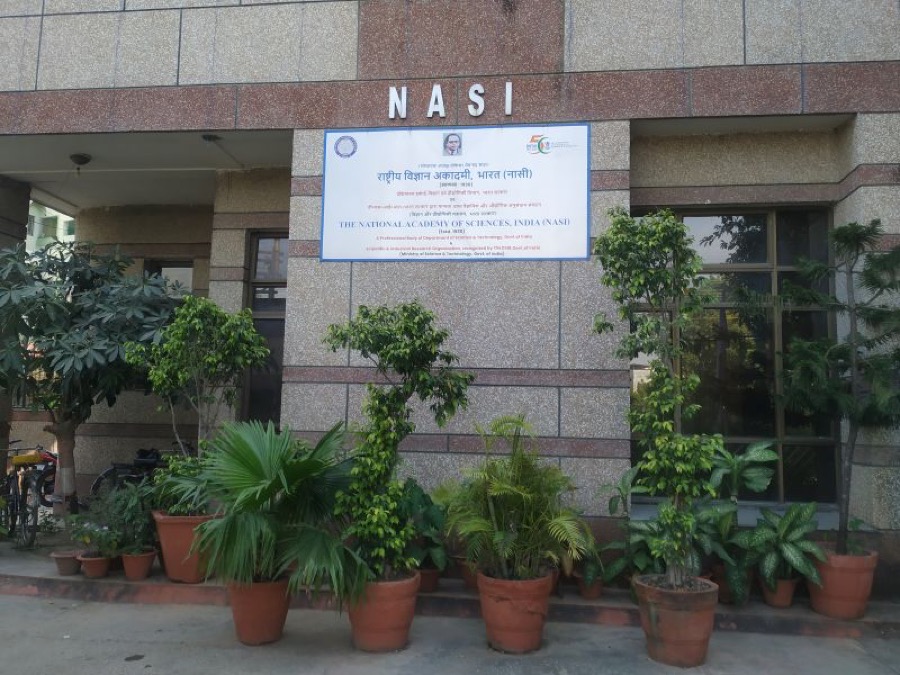
The National Academy of Sciences, India
India’s first Science Academy
The idea of establishing a common forum for Indian scientists was proposed by Prof. Meghnad Saha. His article, “A Plea for an Academy of Sciences”, appeared in the University of Allahabad magazine in December 1929.
The National Academy of Sciences, India was established the following year as India’s first Science Academy. Its guiding principle is “Science and Society.”
Current President: Padmashri Prof. Vinod K. Singh, Former Founding Director, IISER Bhopal.
“An Academy of Science can do a great deal by educating public opinion, undertaking particular problems, and bringing out scientific workers in various fields for discussion and cooperative research. But the main function of the Academy should be towards cultural improvement by contributions to human knowledge.”
Purpose
“To promote and cultivate Science and Technology for societal welfare through the advancement of research and innovation.”
“To advance and foster Science and Technology by promoting research, disseminating scientific knowledge, facilitating discussions on scientific, societal and policy issues, and cultivating a scientific temper for the advancement of Science and Society.”
The 96th Annual Session
Event dates
BHU, Varanasi
NASI Annual Sessions provide a platform for scientific discussion, exchange of ideas, interdisciplinary collaboration and engagement with issues connecting science and society.
This year’s Symposium covers contemporary areas spanning science, technology, policy, innovation and national development.
Symposium themes
Scientific sessions
Sectional President: Prof. Neela Nataraj
Department of Mathematics
IIT Bombay
Sectional President: Prof. Rakesh Bhatnagar
National Science Chair
School of Biotechnology
JNU, New Delhi
Call for papers
Researchers, faculty members, industry professionals, and postgraduate scholars are invited to submit their work for presentation in the 96th Annual Session of NASI.
Contributions may highlight current research, policy implications, emerging technologies, and interdisciplinary approaches aligned with science for societal benefit.